


Past Events
Interested in Cotsen events? Sign up for our mailing list.
Speaker:
Megan Perry
East Carolina University
Associate Professor of Biological Anthropology
Abstract:
The mysterious Nabataeans, builders of the magnificent city of Petra, have long fascinated scholars and the public. Scant archaeological research and minimal textual sources have not clarified the shift from a primarily nomadic encampment in the late 4th century BC into a major capital city by the 1st century BC. Our understanding of Petra’s urban life recently has been transformed with the excavation of tombs within the ancient city. The human skeletal remains from these tombs have illuminated the origins of the city’s residents, their disease profiles, and what foods they relied on in this desert environment. This lecture demonstrates how Petra’s dead can inform what life was like in this ancient city.
Contact Aaron A. Burke (aaburke@ucla.edu) for more information.
Contact Sumiji Takahashi
Email sutakahashi@ioa.ucla.edu
Phone 310-825-4169

Speaker:
Karime Castillo
UCLA Archaeology Ph.D. Student
Bio:
Karime Castillo is originally from Mexico City. She received her B.A. in Archaeology from Universidad de las Américas Puebla and her M.A. in Artefact Studies from the Institute of Archaeology, University College London. She is primarily interested in Mexican historical archaeology and colonial material culture. Her master’s thesis proposes a typology of pharmaceutical glass from London. As a historical archaeologist, she has done research on Colonial Mexican majolica and the Hacienda San Miguel Acocotla, Puebla, Mexico. She has worked for archaeological projects in different parts of Mexico, including Sonora, Mexico City, and Puebla, and has collaborated with the Franz Mayer Museum in Mexico City and London Archaeological Archive and Resource Center in London. At University of California Los Angeles she will study glass production in Colonial Mexico.
Abstract:
difficulties as they established their crafts in the New World. Glassmakers in particular, struggled finding the resources they needed in an unfamiliar land where glass had not been artificially made before. Nevertheless, colonial glassmakers found ways to adapt to the local resources and the industry

flourished in New Spain, predominantly in Mexico City and Puebla. By bringing together archaeology, history, ethnography, and materials science principles and methods, it is possible to explore the processes of technological transfer, adaptation and development of glass production technology in Colonial Mexico. This talk presents some results of the analysis of glass from the two main glass production centers in New Spain. The chemical composition of archaeological glass from Mexico City and Puebla reveals the various ways in which colonial artisans adapted the technology to the resources available in a different and. Historical documents bring to the fore the social aspects of the technology and help to contextualize colonial glass production within the broader scope of Spanish colonialism.
Contact Sumiji Takahashi
Phone 310-825-4169
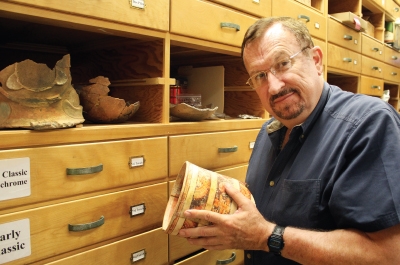
Speaker:
Dr. James Brady
Professor
Dept. of Anthropology
Cal State Los Angeles
Bio:
Dr. James Brady is best known for pioneering the archaeological investigation of Maya caves. Between 1981 and 1989 he directed excavations at Naj Tunich (National Geographic, August 1981, Archaeology Nov/Dec 1986) and from 1990 to 1993 he directed the Petexbatun Regional Cave Survey (National Geographic, February 1993). Moving to Honduras, Brady headed a three year archaeological investigation of the Talgua region (Cave of the Glowing Skulls, Archaeology May/June 1995). Since 2001, he has led a Cal State L.A. field school to Peten, Guatemala. More recently, he has co-directed a project studying Ulama, a modern survival of the ancient Aztec ballgame Ullamaliztli (Archaeology Sept/Oct 2003; Smithsonian Magazine, April 2006). From 2008-2010 he directed the investigation of Midnight Terror Cave in Belize and currently he is working with the Programme for Belize.
Contact Sumiji Takahashi
Email sutakahashi@ioa.ucla.edu
Phone 310-825-4169
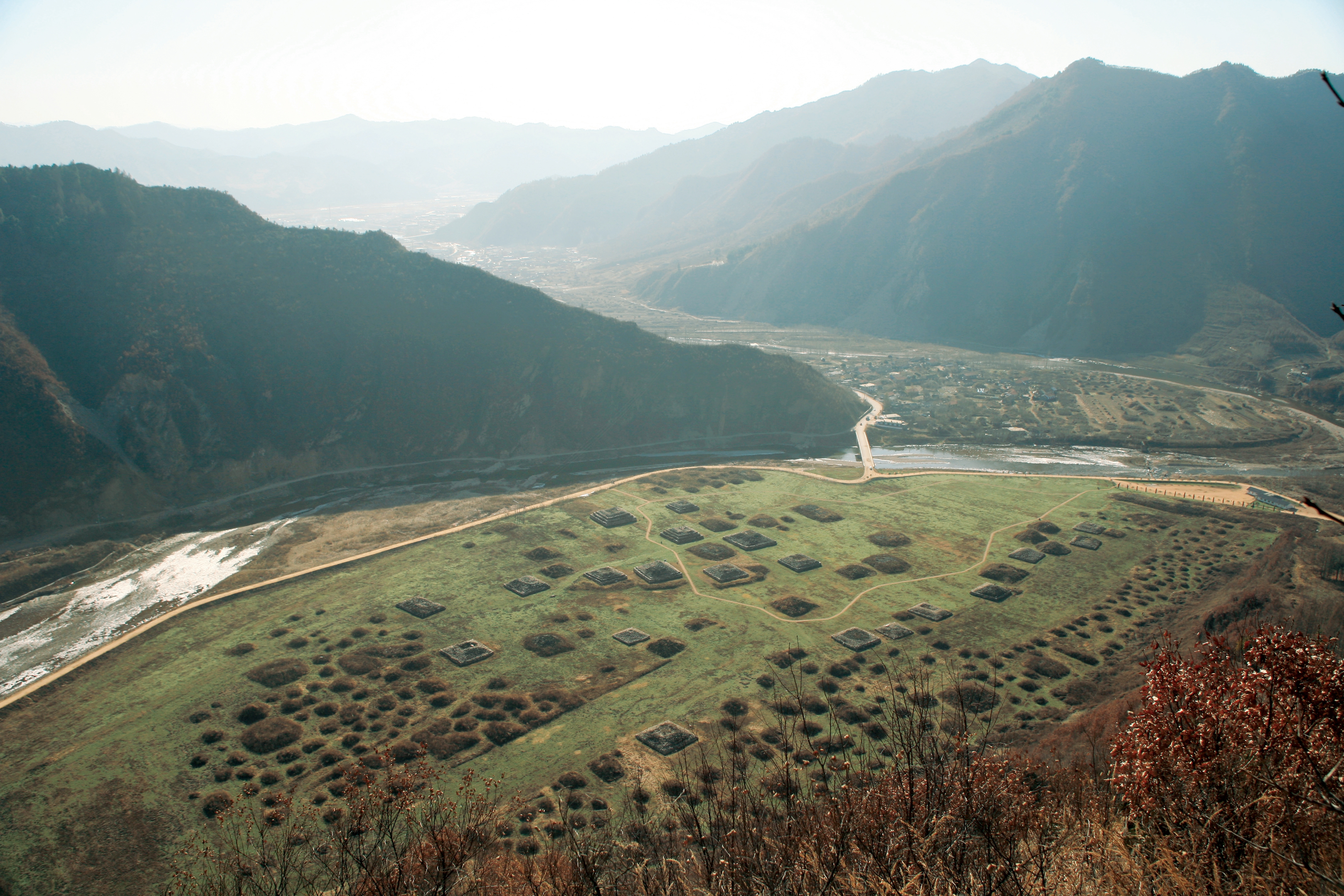
Speaker:
Dr. Sungjoo Lee
Kyungpook National University
Contact Sumiji Takahashi
Email sutakahashi@ioa.ucla.edu
Phone 310-825-4169

Speaker:
Roxanne Radpour
Ph.D. candidate, UCLA
Contact Sumiji Takahashi
Email sutakahashi@ioa.ucla.edu
Phone 310-825-4169
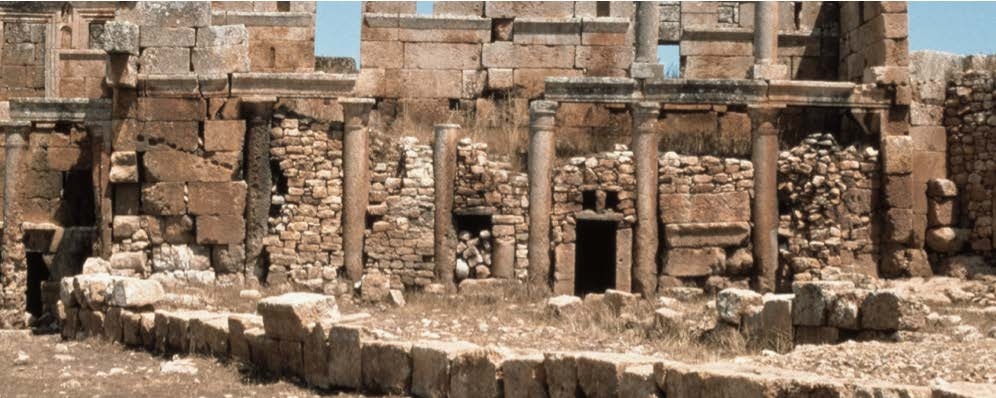
Speaker:
Dr. Ann Marie Yasin
Associate Professor of Art History and Classics
USC
Contact Sumiji Takahashi
Email sutakahashi@ioa.ucla.edu
Phone 310-825-4169
Speaker:
Dr. Stella Nair
Associate Professor
UCLA, Dept of Art History
Contact Sumiji Takahashi
Email sutakahashi@ioa.ucla.edu
Phone 310-825-4169
Speaker:
Dr. Kathleen Lynch
University of Cincinnati
Abstract:
Athenian pottery was exported throughout the Mediterranean in the Classical Period. Perhaps surprisingly, it found eager consumers in the Persian Empire, or rather, in territory controlled by the Persians during the Greek Classical period. The presentation will consider what the imported Greek pottery meant in the context of the Achaemenid empire, with a special focus on Gordion in central Turkey. The former Phrygian capital turned Persian outpost is an anomaly with its abundant, high quality Athenian pottery. Typically Athenian pottery tends to be found in coastal settlements of the eastern Mediterranean, but Gordion is 500 km from any coast. What was the appeal of Athenian pottery?
Contact Sumiji Takahashi
Email sutakahashi@ioa.ucla.edu
Phone 310-825-4169
Speaker:
Dr. Sonia Zarrillo
Postdoctoral Fellow
Cotsen Institute of Archaeology, UCLA
Abstract:
Throughout human history, from our earliest ancestors through to modern societies, plants were of vital significance. They have been essential to diet, used as medicines and in ceremonies, fashioned into a myriad of tools, containers, adornments, and musical instruments, depicted in artwork and used as emblems, and relied on as a source of fuel and building material.
Paleoethnobotany, or archaeobotany, is the study of the interrelationships between people and plants in the past. More specifically, paleoethnobotany is the recovery, analyses, and interpretation of plants from archaeological contexts to answer questions of behavior and ecological interactions between past peoples and plants.
In this lecture, case studies from past and current research – from the northern Plains of North America to the South American Andes – will be presented to illustrate the range of knowledge to be gained from paleoethnobotanical studies, followed by research and volunteer opportunities for students and the interested public.
Contact Sumiji Takahashi
Email sutakahashi@ioa.ucla.edu
Phone 310-825-4169
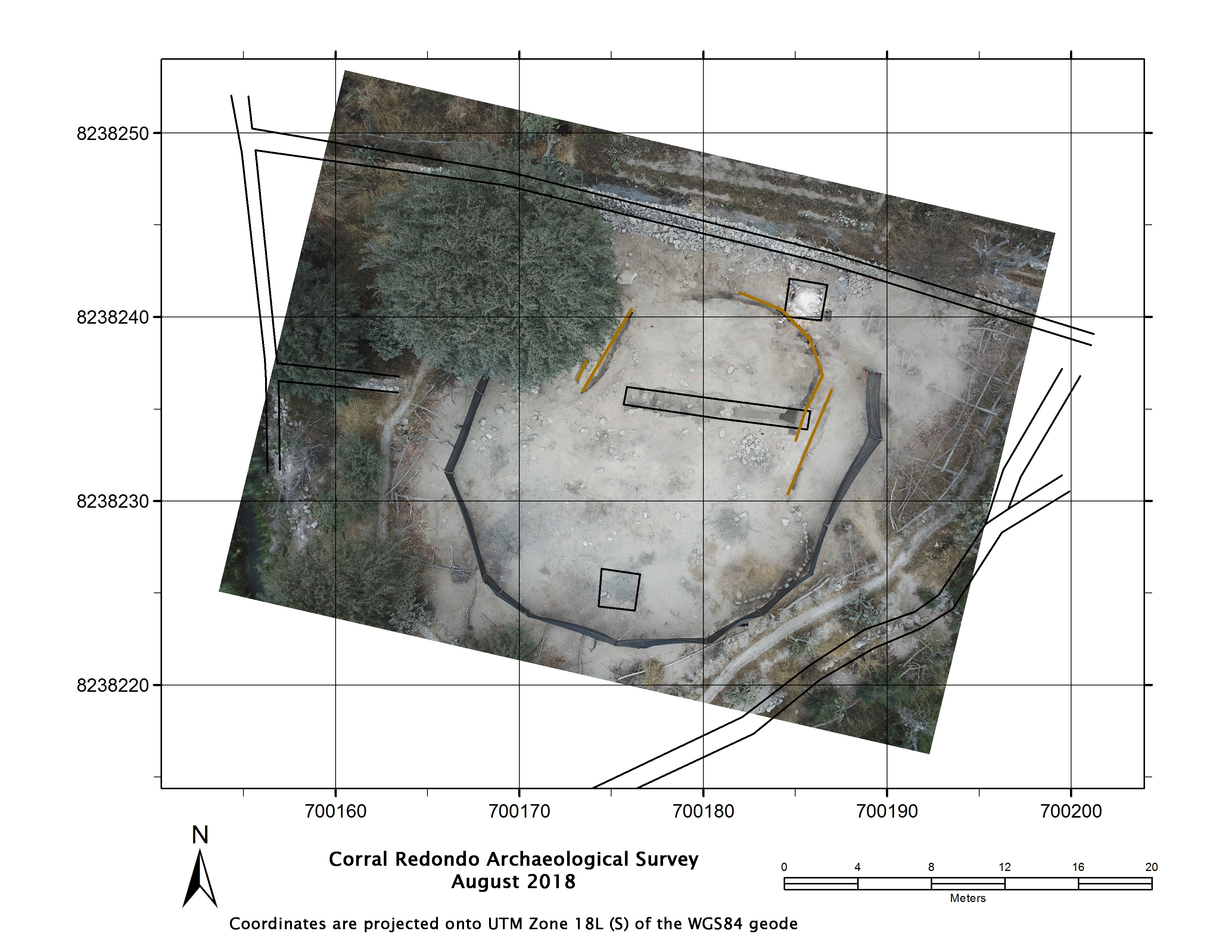
Corral Redondo, Peru: 75 Years Later
Dr. Hans Barnard, UCLA
Dr. Danny Zborover, Institute for Field Research
Vanessa Muros, UCLA
ABSTRACT
Corral Redondo is located in southern Peru, where the Chorunga River joins the Ocoña River on its way from the Andes to the Pacific Ocean. In 1943 Corral Redondo briefly shot to fame after local villagers discovered the site and recovered 96 Wari period (ca. 600‒1000 CE) blue-and-yellow feathered panels, stored inside eight large ceramic face-neck jars. Inka period (ca. 1450‒1550 CE) silver and bronze vessels, as well as gold and silver figurines of camelids and humans, dressed in miniature garments, were found elsewhere on the site. The type and number of artifacts found suggests that the site functioned as a ceremonial compound in both Wari and Inka times. However, because the site was looted and the finds dispersed to museums in Peru and elsewhere, all archaeological information associated with them has obviously been lost. In the summer of 2018 a team from the Cotsen Institute, the University of Chicago, the Institute for Field Research,and local archaeologists visited the Ocoña Valley to investigate and record the remains of Corral Redondo and its wider environs. In this presentation, the first results of this ongoing research endeavor will be discussed.
Contact Sumiji Takahashi
Email sutakahashi@ioa.ucla.edu
Phone 310-825-4169
- ‹ previous
- 13 of 23
- next ›