


Excavating Antioch: The Archaeology of an Ancient City
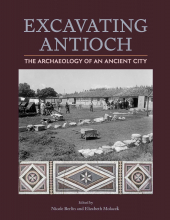
New
ISBN: 978-1-950446-83-4
Publication Date: Sep 2026
Price: Hb $75.00, eBook $75.00
Order this book here!
- Print: Order from our distributor
Return to catalog
Edited by Nicole Berlin and Elizabeth Molacek
Founded in 300 BCE, Antioch-on-the-Orontes was one of the great metropolises of the ancient world—a cosmopolitan center of trade, culture, and religion that ranked among the most important cities of the Roman Empire. Its archaeological record, rich in mosaic pavements, sculpture, coins, and everyday objects, offers a vivid picture of urban life spanning nearly a thousand years. Yet the story of how that record came to light through excavation—and where it ended up—is as complex as the city itself.
In the 1930s, Princeton University led a landmark series of excavations at Antioch under the French Mandate of Syria, assembling an international consortium of American and French institutions. Over eight seasons of fieldwork, the project recovered hundreds of artifacts and was widely hailed as the “dig of the century.” But the colonial structures that enabled these excavations, and the system of partage that dispersed the finds among partner institutions worldwide, produced a fragmented and ethically complicated legacy that has yet to be fully addressed.
Excavating Antioch: The Archaeology of an Ancient City confronts that legacy directly. Drawing on three years of original research, it brings together approximately 120 understudied objects and architectural fragments from the storage collections of four American museums—the Baltimore Museum of Art, Dumbarton Oaks, the Harvard Art Museums, and the Worcester Art Museum—alongside newly digitized archival materials from Princeton University’s archaeological excavation records. Many of these artifacts have never been fully cataloged, photographed, or published.
The result is a reassessment of Antioch’s material culture and its modern afterlife. Essays by leading scholars examine the city’s urban fabric, the institutional ambitions and diplomatic negotiations behind the excavations, the local workers who made them possible, and the journeys these artifacts took from excavation sites in Hatay to museum storerooms across the Atlantic. An object catalogue presents new research on each artifact, reconnecting them with their archaeological contexts and with one another.
At a moment when debates over cultural heritage, colonial collecting, and museum ethics are more urgent than ever, Excavating Antioch offers a model of transparent, collaborative scholarship—and an invitation to see both an ancient city and its modern legacy in a new light.