


Event: WEDS TALKS: Rituals associated with the Qhapaq Ñan: Some Thoughts from the Ancient and Recent Road Materiality in Jauja, Peru
Date & Time
April 1, 2026 - 12:00pm to 1:00pm Save to your calendar
Contact Information
Sumiji Takahahshisutakahashi@ioa.ucla.edu
310-825-4169
Location
Fowler A222 (Seminar Room)Event Type
Pizza TalkEvent Details
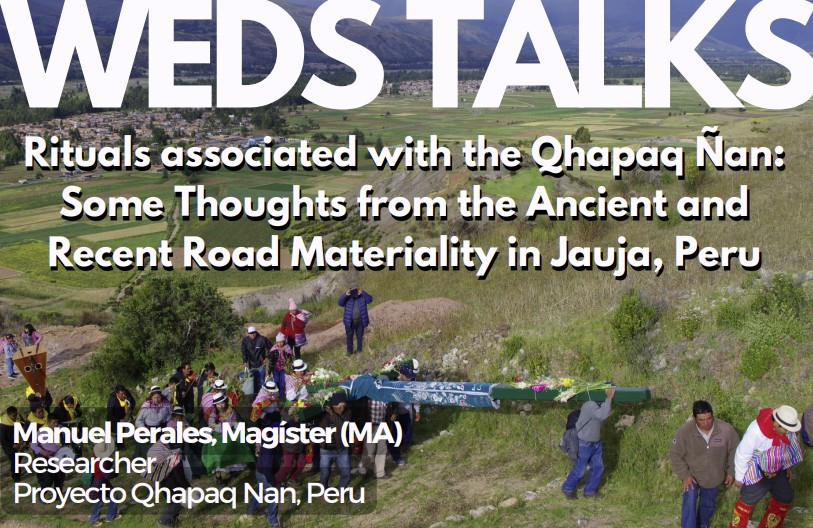
ABSTRACT: The Inca Road System, or Qhapaq Ñan, is undoubtedly one of the most impressive vestiges left by the Inca State, playing a fundamental role in the expansion and consolidation of its domination in the ancient Andes. Currently, scholars have been recognizing that, in addition to its economic, administrative, political, and military role, it also performed important functions in the ideological dimension, manifested in ritual activities that have even transcended the fall of the Tahuantinsuyu. Based on material evidence of ritual activities associated with roads that formed part of the Qhapaq Ñan in the Jauja area of the central Peruvian highlands, this presentation will explore some thoughts about the ideological role of these roads in the incorporation of this territory into the Inca State, as well as in the shaping of new social landscapes that emerged after the arrival of Europeans to this region.
BIO: Manuel Perales holds a Bachelor’s degree in Archaeology from the National University of San Marcos and a Master’s degree in Legal Anthropology from the National University of Central Peru. Manuel also is a graduate of the Master’s program in Peruvian Art History at the Catholic University of Santa María in Arequipa. He is a Corresponding Member of the Institute of Andean Studies in Berkeley, California, and a Corresponding Academician of the National Academy of History of Peru and a member of the Society for American Archaeology in the United States. He has won prestigious awards from CONCYTEC, the American Anthropological Association, and the College of Architects of Peru. Manuel has authored numerous publications within his field of expertise, both in Peru and abroad. Currently, he works at the Qhapaq Ñan Project—National Headquarters, under the Ministry of Culture, and serves as a professor at Continental University; he is also a member of the Julio Espejo Núñez Center for Historical-Social Studies in Jauja.