


Event: WEDS TALKS: Materiality on the Balkan Route
Date & Time
March 11, 2026 - 12:00pm to 1:00pm Save to your calendar
Contact Information
Sumiji Takahahshisutakahashi@ioa.ucla.edu
310-825-4169
Location
Fowler A222 (Seminar Room)Event Type
Pizza TalkEvent Details
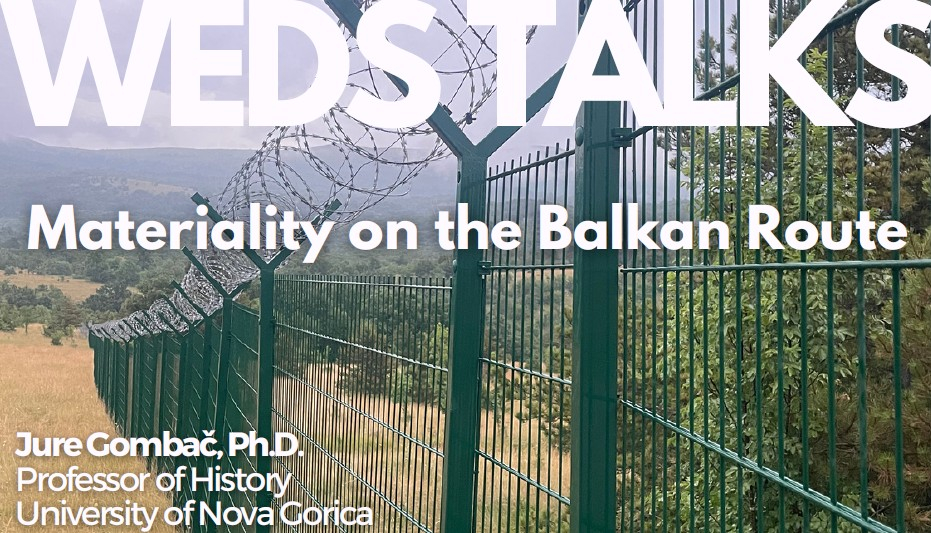
ABSTRACT: The Balkan migrant route is the most important overland migration corridor in Europe, leading migrants from Turkey to Trieste (Italy). Having existed only marginally for decades it was abruptly and informally opened during the “long summer of migration” in 2015. In 2016, already serving a passage of roughly a million migrants, it gradually closed. Changes reintroduced the previous border regime, but now fortified with walls and enhanced by technological advances (thermal imaging cameras, night vision goggles, tracking devices, surveillance towers, biometric borders). Despite the formal closure of the corridor, it remains one of the most active escape routes for migrants. In 2022, around 145.600 irregular border crossings were reported by Frontex, EU border forces. But while it is still “informally open and active” it no longer resembles its previous forms. Crossing borders is nowadays harder and it takes longer. Journeys are illegalized and thus clandestine, ruptured by pushbacks and periods of waiting. The presence of migrants in transit countries is tolerated, with common episodes of harassment and violence. Given the new situation on the Route, migrants usually “disappear” below the threshold of perceptibility – from institutional camps into makeshift camps, and from walking paths, buses, and passenger trains, into cargo trucks, smugglers vehicles, under the trains, into the forests. Their paths lead through wild uninhabited areas, and their settlements are usually set up in “peripheral and unused places” until they are evicted or demolished either by the police or locals. Since 2016, BMR is known to change rather quickly – new micro-routes are emerging and re-emerging, migrants are endlessly reinventing passages to cross the borders through so-called “games”, and reach their destination despite the high risks, obstacles and potential violence. During the “games” – to aid walking and resting, and during periods of “temporary settlement” – migrants use a limited, but important number of objects to help with their mobility.
Bio: Jure Gombač has a PhD in sociology and is a professor of history. His research focuses on migration studies, with an emphasis on migration theory, border studies and the integration of migrants into society and the labour market. At the University of Nova Gorica, he teaches the undergraduate course in Cultural History and the European Master in Migration and Intercultural Relations (EMMIR).