


Event: WEDS TALKS: Dōtaku Reconsidered: Skeuomorphism, Size, and Value in Yayoi Period Japan
Date & Time
May 13, 2026 - 12:00pm to 1:00pm Save to your calendar
Contact Information
Sumiji Takahahshisutakahashi@ioa.ucla.edu
310-825-4169
Location
Fowler A222 (Seminar Room)Event Type
Pizza TalkEvent Details
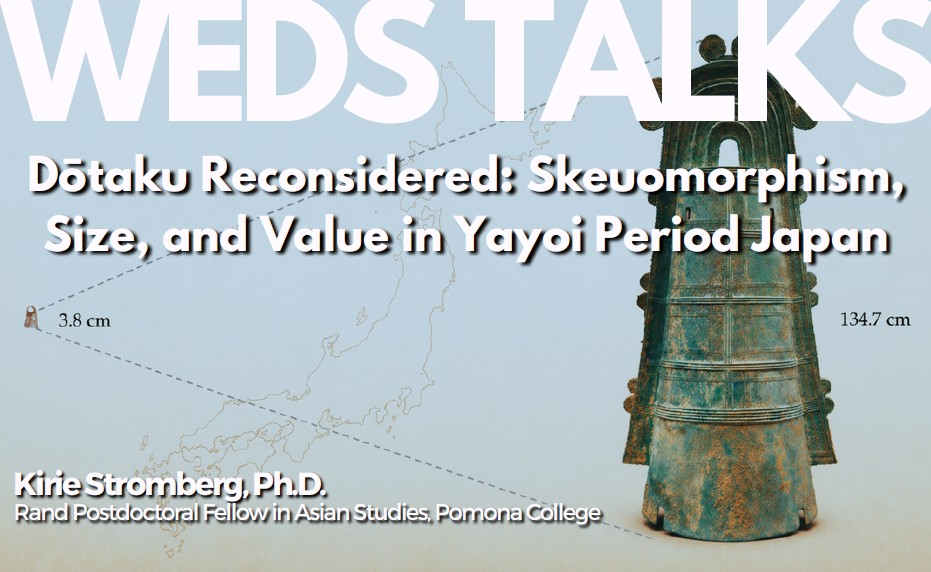
ABSTRACT: Over 500 dōtaku (銅鐸) bronze bell-shaped objects, traditionally dated to the late-middle Yayoi until the beginnings of the Kofun period (ca. 200 BCE-250 CE), have been excavated predominately from the central Kinki region of the Japanese archipelago. However, this number does not include so-called “small dōtaku” (小銅鐸) or pottery miniatures (銅鐸形土製品), seldom included in analyses of larger examples. Adopting a macroscopic geographic and chronological perspective on a historically circumscribed topic, this presentation and (re)considers dōtaku of all sizes and materials within the framework of early East Asian skeuomorphism, as related to the development of the broader Bronze Age economy.
BIO: Kirie Stromberg completed her PhD at the Cotsen Institute of Archaeology at UCLA in 2023 and currently serves as the Rand Postdoctoral Fellow in Asian Studies at Pomona College. She was a recipient of the US Department of Education Fulbright-Hays Doctoral Dissertation Research Abroad fellowship for her dissertation (“Music and Political Authority in Early China and Japan: Pre- and Protohistory”), for which she was was based at Kyushu University in Itoshima, Japan. Her work elucidates the relationship between musical material culture and the formation of complex society across early East Asia. She is currently writing the first monograph in a Western language about Yayoi period (ca. 900 BCE-250 CE) dōtaku bronze bells, as well as their reception in medieval and early modern Japan.